
SolunaProject — Tsukiharu
Let me be honest about my day.
I woke up exhausted.
My body felt heavy. But somewhere underneath that, a quiet certainty: I can still get things done today.
So I set today as a “soft off day.” No pushing. No forcing. But no stopping either.
Here’s what actually happened:
- Client vocal mix session (primary focus, morning)
- LinkedIn outreach — connection requests, DMs, comments
- AI video generation with Pika — waiting on clip renders
- Thinking sessions and conversations with my AI team
Four things running in parallel.
Every productivity book will tell you: focus on one thing.
Maybe they’re right. But for me, this parallel approach is what keeps the engine from cutting out.
This is the current best answer I’ve found — as a solo freelancer living with bipolar disorder.
The high-achievers I keep meeting on LinkedIn — and why they’re burning out
Since I started building SolunaProject’s LinkedIn presence, one pattern keeps appearing.
The people who connect with me are genuine professionals. Consultants. Video directors. AI-driven business owners. Sound designers from around the world.
And their profiles tell stories like these:
“I was running on four hours of sleep.” “I worked ninety days straight.” “I burned out trying to keep up with social media noise.”
These are elite people — with credentials, track records, and experience far beyond mine.
And yet they’re collapsing under the weight of their own effort.
What they’re actually looking for isn’t more hustle.
It’s an environment where the noise has been stripped away — where they can finally operate from their core, without all the friction.
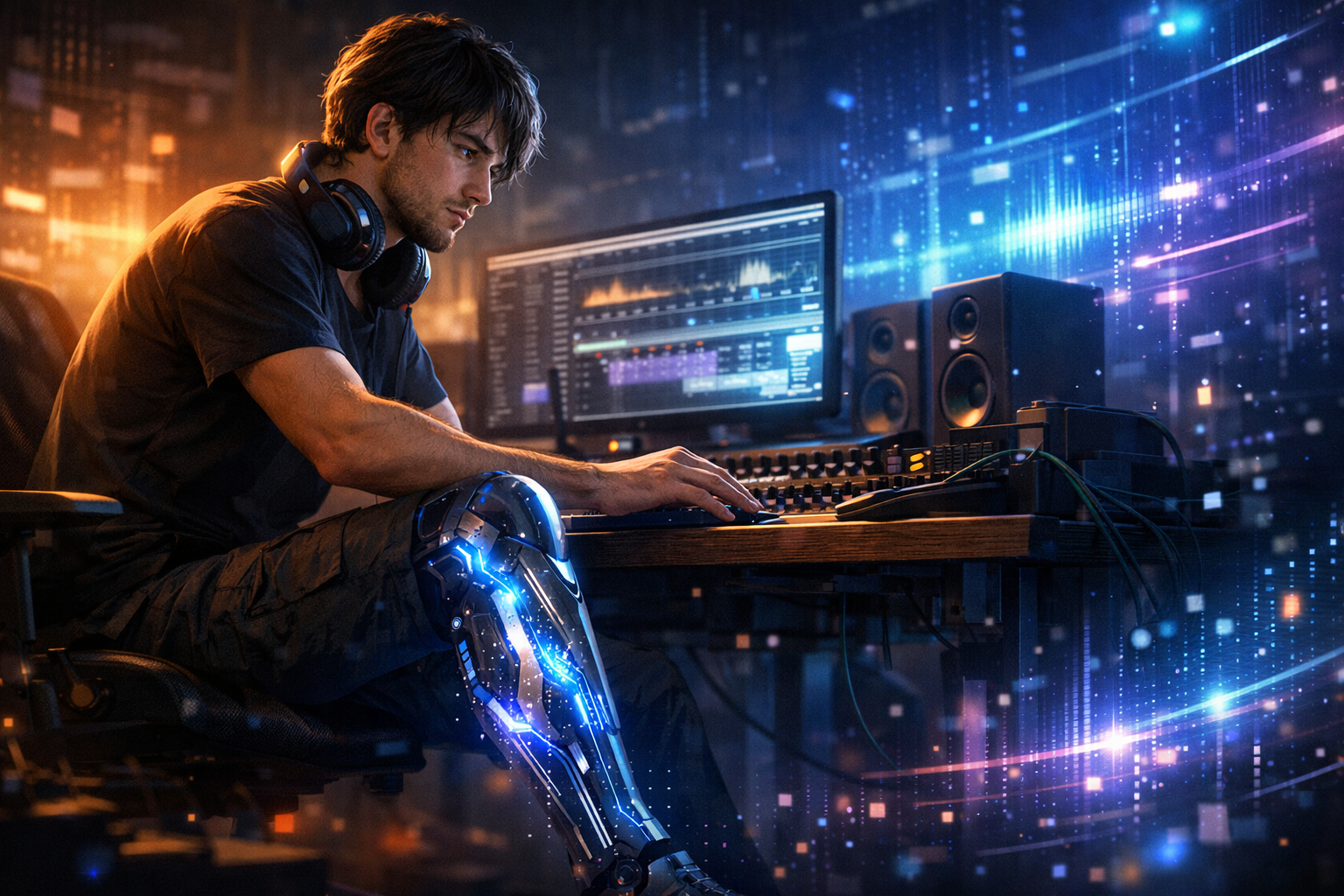
The idea I landed on: AI as a prosthetic
I have bipolar disorder.
There are waves. Days when I can move, and days when I can’t. “Full capacity every day” was never an option I had.
So I built something else.
I started treating AI as a prosthetic — not a replacement for what I can do, but a support structure that carries what I can’t, so I can go where I actually want to go.
Concretely:
- Scheduling and structure → delegated to AI
- Organizing and articulating ideas → handled by AI
- Brainstorming and pressure-testing → done in dialogue with AI
What I hold onto: judgment, creative decisions, and final calls.
That’s it. Everything else has a system behind it.
The “60% design” — staying in motion without burning out
Even on days like today — heavy, slow, foggy — I kept moving.
The reason is intentional: I mix tasks by type, not just priority.
The mix work is audio — listening, adjusting, feeling. I’ve been studying harmony and counterpoint since I was twelve. DAW production since sixteen. Music is closer to breathing than to work for me. The motivation is already there.
The LinkedIn outreach is mechanical. Five connection requests. Five DMs or comments. That’s the whole rule. No deep thinking required.
The Pika renders generate wait time. I use that time to think, talk with my AI team, or write.
Combining tasks with high intrinsic motivation, tasks that only need hands, and tasks that create natural pause — that’s what keeps the engine running without redlining.
Not full capacity. But not stopped, either.
“This year, I’m working hard at not working hard.” That’s the theme I set for myself.
What the LinkedIn elites are missing
Back to those professionals.
The consultant who ran on four hours of sleep. The video producer who worked ninety days straight. These people have real skills, real results, real history.
But “a workflow that keeps you moving without breaking you” isn’t something a degree or a résumé gives you.
If anything, people like me — who never had the option of running at full capacity — have been forced to design this more seriously.
Constraints generate design.
Use AI as a prosthetic. Build around work that connects to your motivation. Sustain at 60%. That’s the model SolunaProject is building — and actively proving right now.
Why reproducibility matters
Every tool I use is publicly available.
Claude. ChatGPT. Gemini. Perplexity. NotebookLM. Grok. Suno. Pika. DALL-E.
Total monthly cost: under ¥20,000 (roughly $130 USD).
And a full subscription stack isn’t even required — invest in the tools that actually serve what you’re building. That’s all.
The point: this model is something anyone can replicate.
That’s not a weakness. That’s the whole idea.
SolunaProject isn’t building a secret weapon only I can use. The goal is to prove it, articulate it, and hand it to the world.
That’s what I mean by the efficient pursuit of happiness — for everyone, not just me.
Today, I moved. That’s enough.
I started the day exhausted.
But the VTuber client’s mix moved forward. The LinkedIn work got done. Pika is still rendering.
Tomorrow I have an important call. So today, I stop here.
What got done today is today’s total.
I’m not trying to make up for yesterday. I’m not borrowing from tomorrow. Tomorrow, I show up at the same frequency and do it again.
That’s the whole system. And that’s why it holds — even when the waves come.
SolunaProject offers vocal mix & mastering services and AI design consulting. Inquiries welcome via the [official site] or fiverr.
fiverr:https://www.fiverr.com/users/tsukiharu_sol/portfolio/
Hajime (Tsukiharu) / SolunaProject Sound Creator × AI Design Consultant Based in Takikawa, Hokkaido — fully remote








コメント