
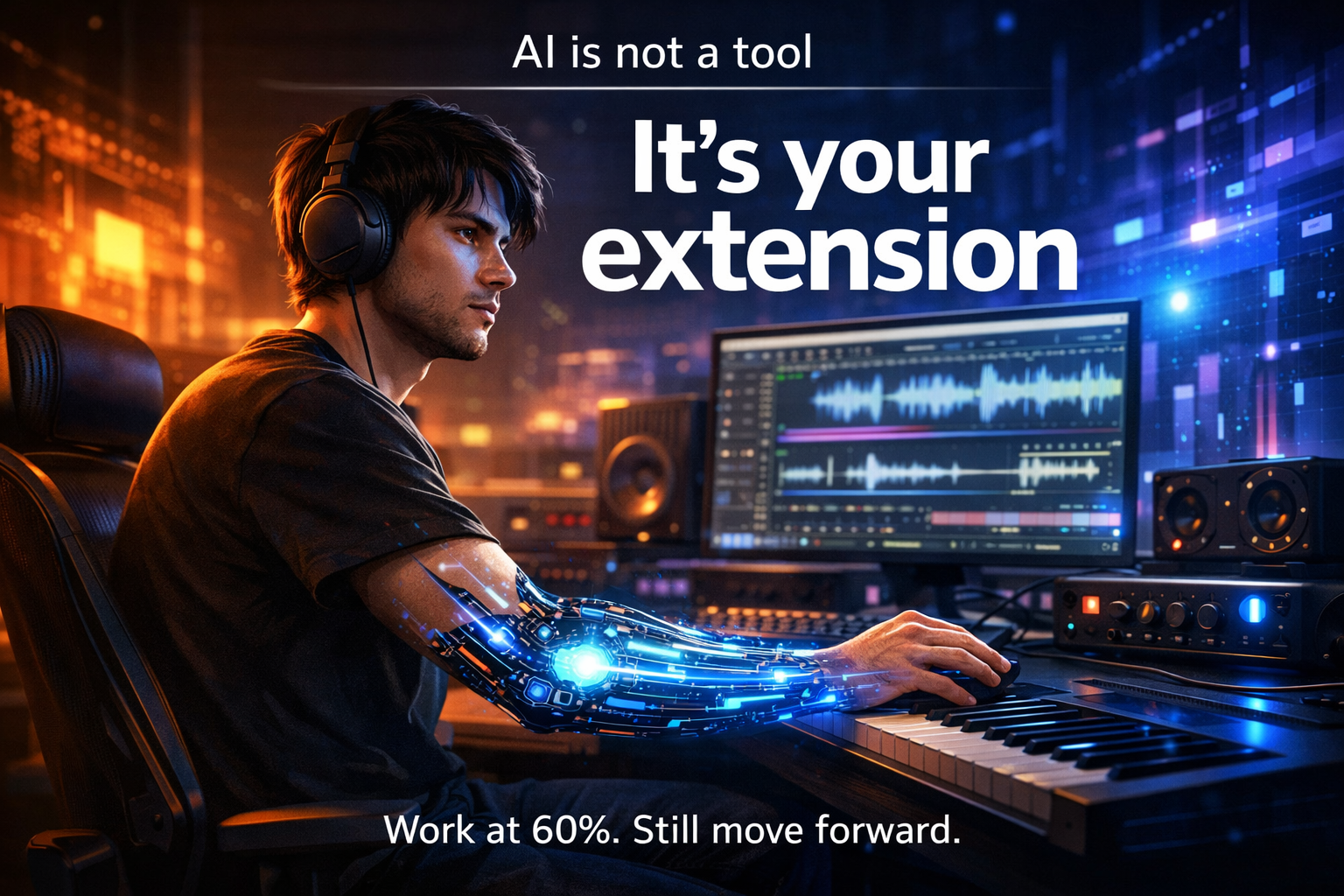
Today was another 60% day.
Body heavy. Energy at maybe half.
And yet — the client mix moved forward. The LinkedIn post went out. The AI renders are still running.
Not because I pushed through it.
Because I stopped designing my work around full capacity.
I have bipolar disorder.
A workflow built on full output was never an option for me.
“Push through it.” “Go all out every day.” “90-day streaks.” Every time I saw that kind of language, it felt like someone describing life on a different planet.
My body doesn’t work that way. Good days exist. So do days when I can barely move. That wave isn’t something willpower can control.
So I built something else instead.
The “Built to Break” Success Model — and Why I Got Off It
Most modern productivity frameworks share the same underlying structure.
People who can run at full capacity — running even faster.
Sleep gets cut. Weekends get cut. Eventually, something human gets cut. And as long as the numbers hold, it’s called success.
But I’ve seen what comes after. Burned-out consultants. Broken creatives. Freelancers who simply disappeared one day.
It wasn’t a skill gap. It wasn’t a lack of drive.
The model they were running on was designed to break from the start.
I didn’t have the stamina to run that model. So I stepped off it entirely — and started designing something that wouldn’t collapse.
The Day I Stopped Using AI as a Tool
The shift happened when I stopped thinking of AI as a tool.
Tools assume the person using them is operating at 100%. A hammer is useless without an arm to swing it.
A prosthetic is different. It compensates for what’s missing and carries you where you actually want to go.
That’s what I needed AI to be.
A structure that keeps moving even on the days I’m running at 60%.
Here’s what the actual design looks like:
→ High-motivation work (audio mixing) as the core → Low-friction tasks (LinkedIn outreach) filling the gaps → AI render wait times used for thinking and planning
Three streams running in parallel. If one slows down, the others keep going.
On a 60% day, the goal isn’t “do everything.” It’s “let 60% move forward.” That’s enough.
Constraint Built the Design
Here’s the paradox: I only arrived at this system because I had no other option.
When you can push through on willpower, you do. You don’t stop to design. And eventually, you break.
I never had that choice. So I thought harder.
What does a workflow that doesn’t collapse actually look like?
People forced to design around limitation tend to find this answer first. That’s not irony. It’s not a boast. It’s just what happens.
What “AI Prosthetic Workflow” Actually Means
I call this the AI Prosthetic Workflow.
The point isn’t to make AI the center. It’s to keep your own motivation and creative instinct at the core — and let AI carry the parts that would otherwise drain you.
Your skeleton. AI as the structure supporting it.
That’s when the frustrating feeling of “I’m using AI but losing my voice” disappears. AI is a thinking aid, not a replacement for thought. The order of operations changes everything.
So — What Are You Going to Do?
If you have the skills. If you have the drive. And things still aren’t moving —
The problem probably isn’t talent.
You might just be running on a model that was built to break.
Which means there are two choices.
Stay on it. Or build something designed around how you actually work.
Either is a valid choice. But until you choose — nothing changes.
The day I started treating AI as a prosthetic, the structure of my work changed.
Whether yours does is entirely up to you.
SolunaProject — Human and AI, Co-creating Sound Creator × AI Design Consultant — Tsukiharu










コメント