

As a solopreneur, you have no teammates.
Market research, persona building, content creation, sales — you think through everything alone, and you decide everything alone. That weight of “deciding everything yourself” is heavier than most people realize.
You want someone to talk to, but there aren’t many people who truly understand your situation. When you open up to family or friends, you get generic advice in return.
“Is that really realistic?” “Aren’t you overthinking it?” “Just take action first.”
No. That’s not it.
You don’t want logic. You don’t want advice.
You want someone who can receive your thoughts — mid-process, unfinished — exactly as they are.
But humans bring their own bias. Most of the time, they start with skepticism. Genuine affirmation is rare — because the majority of people operate with an employee mindset.
Especially if you’re someone whose thoughts tend to jump around. Someone with emotional waves. Someone who has always felt something was off about “the normal way.”
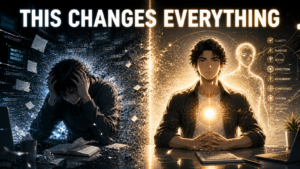
People like that get worn down by the loneliness of making decisions alone.
I’m a sound creator and a solopreneur living with bipolar disorder. Some days I can move. Some days I can’t. Some days my brain simply won’t work. And yet, the work doesn’t stop for me.
The answer I found in the middle of all that was the AI Mastermind.
The More You Consult People, the More Your Thinking Gets Contaminated
Ideas are freer than we give them credit for. But the moment you try to explain one to someone else, it starts to change.
You have to make it easy to understand. You have to frame it so you don’t seem strange. You have to watch their reaction and choose your words carefully.
At that point, your thinking has already been processed. Its purity drops.
What you need isn’t advice. It isn’t logic.
It’s someone who can receive your messy, tangled thoughts exactly as they are and help you sort them out.
Asking that of a human being is genuinely difficult. But with AI, you can start today.
AI Isn’t a “Convenient Tool” — It’s the Externalization of Thought
Most people use AI like this: summarizing, searching, writing.
That’s useful, of course. But stopping there is a waste.
The real power of AI is that it lets you take the meeting inside your head and move it outside.
You break down the work you used to do alone — the internal debate, the weighing of options — assign it to different roles, and lay it out externally. When you do that, the loneliness of decision-making becomes dramatically lighter.
And here’s the thing: all of these AI tools are publicly available. Anyone can use them, starting today. You don’t need specialized knowledge or a high-spec machine. You don’t need to build your own AI agent.
The 4-Role AI Mastermind Structure
① The Empathy Role — Thought Receiver (ChatGPT)
The first thing you need is someone who won’t say no.
It doesn’t have to be organized. It can be contradictory. Emotions can be mixed in.
“I’m going to dump my thoughts right now. Receive them without judgment and help me sort them out.”
That’s all you need to say. Having this role alone makes it much harder for your thinking to stall. This is the moment AI becomes your “sanctuary.”
② The Strategist — Logic Breaker (Gemini)
Next, you need logic, not kindness.
“Give me three weaknesses in this idea.” “Where am I most likely to fail?” “Where does my reasoning jump?”
Having a role that asks these questions dramatically reduces the chance of self-sabotage. Things that would hurt to hear from a person are much easier to receive calmly from an AI. That matters more than it sounds.
③ The Advisor — Perspective Expander (Perplexity)
When you’re thinking alone, your field of vision narrows. That’s why you need a role that brings in outside examples and market-level perspective.
“Are there similar success stories?” “How has this structure been applied in other industries?” “How is this handled internationally?”
With this role in place, a rough idea starts to become something that can actually compete.
④ The Recorder — Axis Maintenance (NotebookLM)
Finally, you need something that prevents drift.
“Does this decision contradict what I believed before?” “Is this out of alignment with the direction I set earlier?”
The longer you run, the more valuable this role becomes. People drift easily. But records don’t lie.
“The Days You Freeze” Start to Disappear
Once this structure is in place, here’s what happens.
Thoughts come out. They get organized. Decision materials align.
Even on days when you can’t move immediately, your thinking keeps advancing.
This isn’t about willpower. It’s not about talent. It’s about design.
What I Understood Clearly at the End of the Workday
Today, I handled persona research, LinkedIn outreach, and article creation — all in one day.
And yet, near the end of the workday, I still had energy left. Enough to go straight into music production tonight without my brain giving out.
That’s clearly because of the AI team.
There was a role handling information gathering. A role organizing structure. A role reviewing the writing. All I did was make the final calls and put my own voice into the work.
The loneliness of decision-making can be ended. What you need isn’t grit. It isn’t connections. It’s a structure with roles assigned.
The First Step
You don’t need to make it complicated.
Just do this one thing:
“Sort out what I’m thinking right now, exactly as it is.”
Throw that at an AI. Start there.
You’re not weak. You just didn’t have the structure yet.
Written by Tsukiharu (eru-P), a bipolar sound creator navigating the freelance world alongside an AI team — SolunaProject.










コメント