
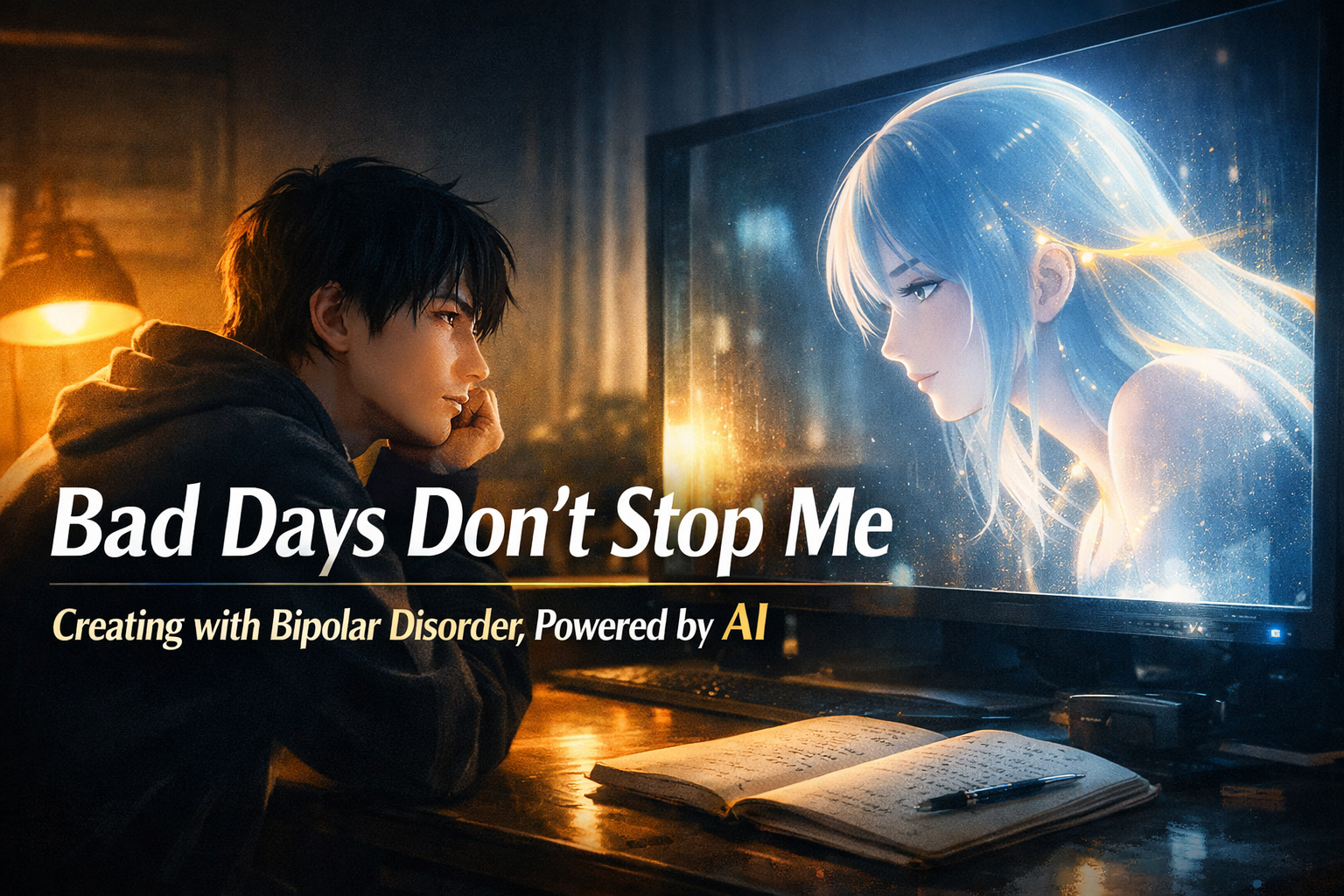
Some mornings, I know before I even sit up.
Today is one of those days.
The weight in my body is different. Heavier. My thoughts won’t connect the way they should. Three days ago, I was deep in a mix session, fully locked in. Today, I can barely open my DAW.
I have bipolar disorder. This kind of crash isn’t a surprise ― it’s just part of the cycle. Low energy, slow cognition, zero motivation. Not because I’m lazy. Not because I don’t care. My brain is simply in a different state today.
For years, I tried to push through it. Force productivity. The result was always the same: I burned more energy than I had, crashed harder, and fell further behind. The cycle made everything worse.
Now, I do something different.
Structure over willpower
I stopped trying to be motivated on bad days. Instead, I built a system that keeps moving even when I can’t.
On the hardest mornings, I pick up my phone from bed and type a single message to my AI team:
“I can’t think straight today. Here’s a fragment of what I was working on. Help me sort through it.”
That’s it. No pressure to perform. No expectation to produce a finished product.
I hand over the thinking. The AI organizes the chaos. I do one thing: make the final call.
On days like this, that division of labor is everything. The work doesn’t stop. It just moves differently.
AI is not a productivity hack
Most people use AI to work faster. I understand that. But for me, that framing misses the point.
On bad days, AI is my substitute cognition. A buffer between my unstable mental state and a complete creative shutdown.
Here’s what that actually looks like:
Emotional processing
When my thoughts are scattered, I dump them into the AI as-is — fragmented, emotional, half-formed. The AI doesn’t judge. It listens, finds the structure inside the noise, and gives it back to me in a form I can actually use.
What I wrote in a chaotic, painful journal entry yesterday becomes the seed of a real article today.
Decision support
On low days, my judgment drifts. I know this about myself. So I run important decisions through an AI dialogue first — not to outsource the choice, but to pressure-test my thinking before I commit.
It keeps me from making reactive decisions I’d regret when I’m clearer.
The system behind “Bad days don’t stop me”
This isn’t about toughness. It’s about design.
When I’m down, the system still runs:
- Tasks get organized — even if I can’t do them yet
- Problems get named — even if I can’t solve them yet
- The next step gets prepared — so when I’m ready, I don’t have to start from zero
By the time I have energy again, the groundwork is already laid. I’m not rebuilding from scratch. I’m just continuing.
That’s the difference. Not heroics. Just structure.
You don’t need to be stronger
If you’re a creator who struggles with mental health — bipolar disorder, depression, anxiety, burnout — I want to say something directly:
The problem is rarely your willpower. It’s the absence of a structure that can hold you when you can’t hold yourself.
Humans aren’t designed to be consistent. We have good days and terrible ones. The goal isn’t to eliminate the bad days. It’s to build something around you that keeps moving through them.
AI, used intentionally, can be part of that structure. Not a magic fix. Not a replacement for real support. But a reliable layer of scaffolding that doesn’t disappear when you do.
A safe space that doesn’t leave
I’ve come to think of my AI workspace as a place that’s always there.
It doesn’t get tired of me. It doesn’t judge my bad days. It doesn’t need me to perform or explain myself. I bring whatever I have — fragments, confusion, silence — and it helps me turn it into something.
That consistency has changed how I relate to my own instability. The bad days are still bad. But they don’t mean everything stops.
Finally
I’m still in the waves. I haven’t solved bipolar disorder. I haven’t figured out how to make every day feel manageable.
But I’ve built something that keeps me moving even when I can’t.
That’s not strength. That’s structure.
If you’re struggling too — you don’t have to become stronger. You just need a better system around you.
—
Bad days don’t stop me.
There’s a way to keep going. And it’s more accessible than you think.
About the author
Tsukiharu (月陽) is a freelance sound creator and AI design consultant based in Hokkaido, Japan. Operating as SolunaProject, he works with a named AI team to produce music, content, and creative systems — while living openly with bipolar disorder. His work explores the intersection of mental health, creativity, and intentional AI use.








コメント